
Fragrance OEM and ODM Services: A Small-First-Order Buyer Checklist
A small first order is not a scaled-down version of a big order; it is a different transaction with a different set of risks. Its real job is to prove that the manufacturer can repeat your approved sample, document every batch, and hand over a compliance pack your market accepts, at volumes where each of those things is easiest to skip. Buyers who treat the first run as a test of process rather than a test of the scent usually learn the most per dollar spent.
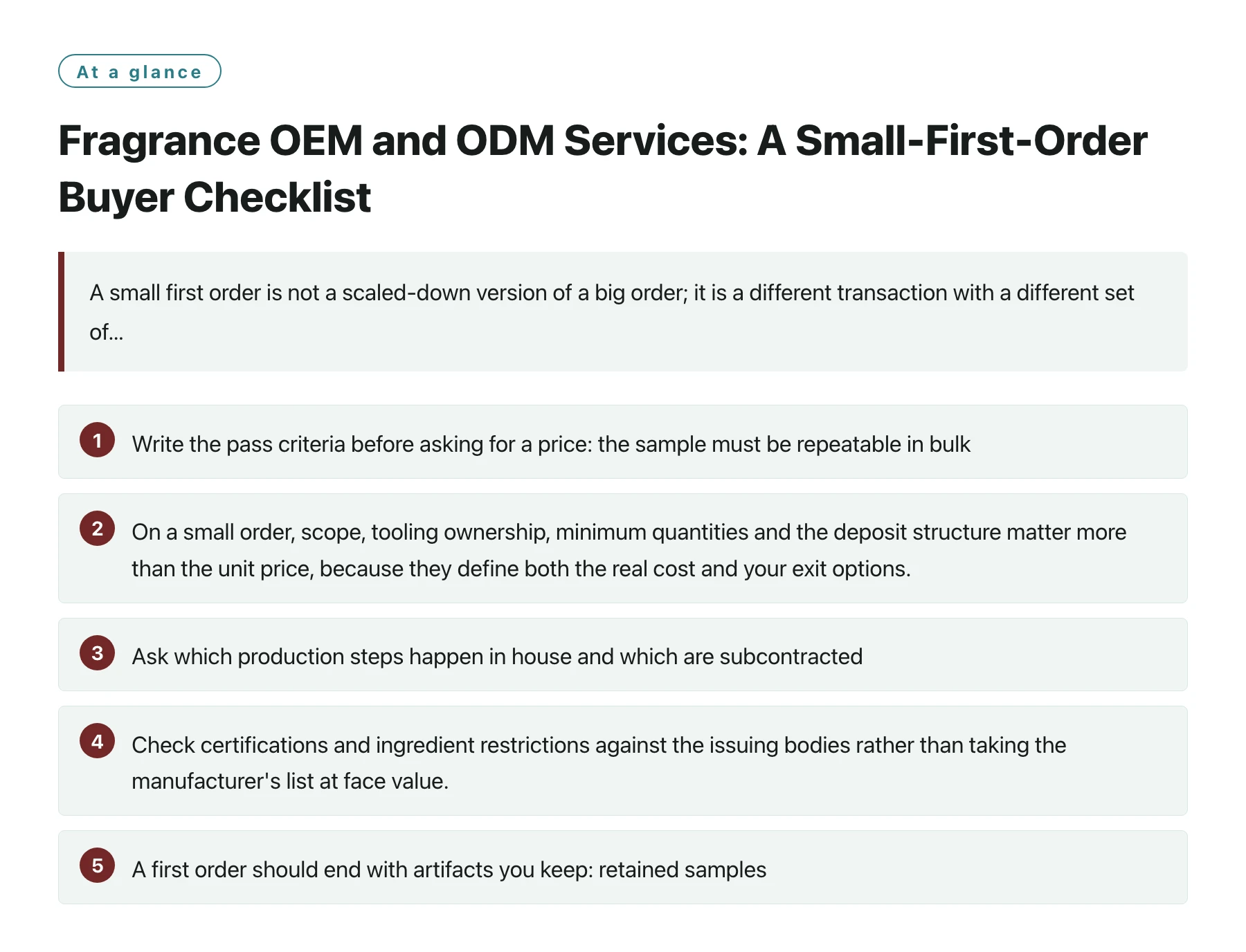
Key takeaways
- Write the pass criteria before asking for a price: the sample must be repeatable in bulk, every batch must be documented, and the document pack must match your destination market.
- On a small order, scope, tooling ownership, minimum quantities and the deposit structure matter more than the unit price, because they define both the real cost and your exit options.
- Ask which production steps happen in house and which are subcontracted; the answer changes lead time, quality risk and how easy the quote is to compare.
- Check certifications and ingredient restrictions against the issuing bodies rather than taking the manufacturer's list at face value.
- A first order should end with artifacts you keep: retained samples, batch records and certificates of analysis, because the second order will be audited against them.
Most buyers start a fragrance supplier conversation with the price per bottle, and that is the least useful thing to ask for first. The price depends on decisions that have not been made yet: who owns the heavy work, which steps are covered by the quote, how small the order really can go, and what documentation the buyer's market requires at import.
This checklist is written for the small first order specifically. It assumes the buyer is testing a supplier, a category or a price point rather than commissioning a full brand launch, and it is ordered the way a conversation ought to go: scope first, terms second, verification third, evidence last.
Start with the service scope, not the price
Fragrance OEM and ODM services cover more than blending. The useful question is which parts of the chain the manufacturer actually controls: formulation, compounding, filling, bottle decoration, packaging design, assembly and testing. Each step that is subcontracted adds a hand-off, and each hand-off is a potential delay and a potential quality gap for a small order that has no slack built in.
A manufacturer that runs most of these steps under one roof will usually answer this question with a single written list, which makes the quotation much easier to compare against another supplier's. A plant organised around a manufacturer that supports OEM and ODM removes a layer of coordination that a first-time buyer never sees until something goes missing at the filling stage.
What the quote should line up with
Lay the quoted unit price next to the written scope. If filling, decoration and testing are excluded from the number, the price is not really a price, it is a starting bid. Ask for the same scope definition from every supplier you approach so the comparison stays honest.
Which steps carry the most risk at small volumes
Decoration and assembly are the steps that quietly break small orders: minimum batch sizes for printing tools, setup charges that dwarf the order value, and artwork that must be colour-matched by eye. Nothing in the fragrance itself causes these problems, which is why they often surface only after the deposit is paid.
The small-order checklist, line by line
| Checklist item | What it tells you | Why it matters at small volumes |
|---|---|---|
| Written service scope | Which steps are in house | Hand-offs multiply delays when the batch is small |
| Minimum order quantity | The real floor for the run | A stated MOQ that matches your cash is table stakes |
| Tooling and mould ownership | Who holds the physical assets | Moulds bought by you are assets; paid by supplier, they stay there |
| Deposit and milestone terms | How cash moves across the project | Structured milestones protect both sides on an unknown run |
| Batch record availability | Whether the run is traceable | Without it, quality problems cannot be investigated later |
| Document pack for your market | Whether the goods can clear import | The most common reason a small order fights customs at all |
Read the rows in this order: scope and MOQ decide whether the project fits you at all; tooling, deposits and documentation decide how much it actually costs and how badly it can go wrong.
Where a small order differs from a large one
Large orders get attention because they justify it. A small first order gets attention only if the supplier treats it as the start of a relationship. That difference is visible in the terms, not in the sales call.
Tooling you paid for belongs to you
Bottle moulds and decoration tools can be protected as industrial designs, and registration is only useful if the brand, not the supplier, holds it [1]. On a small order the mould is often the most expensive line item per unit, so its ownership should be written into the quotation terms, not assumed.
Minimums hide in plain sight
Ask for the minimum order per SKU and per run separately, and ask what happens between the two. Some suppliers quote a low per-SKU minimum but a much higher run minimum that only appears when the volume is confirmed. The second number is the one that matters for cash planning.
Deposits should follow milestones
A fixed deposit split across defined milestones - brief confirmed, samples approved, bulk ready - protects the buyer when the project has not been proven on the supplier's line before. It is a sign of a process-minded partner rather than an inconvenience.
The cheapest mistake is ordering the smallest volume that still produces a real batch record. If the run is too small to generate the documents you need for your market, the first order has taught you nothing about the supplying.
Verification before the deposit
A certification list is the starting point of a verification conversation, not the end of it. Ask for certificate numbers and the issuing bodies, then check them directly. A cosmetics GMP framework such as ISO 22716 exists to make traceability routine rather than exceptional, and testing providers aligned with it cover the microbiological, stability and safety checks a finished product needs [2].
Ingredient-side restrictions deserve the same treatment. The fragrance industry publishes usage limits for individual ingredients based on safety assessments, and a manufacturer should be able to show that its formulae are reviewed against the current version of those limits [3]. If the answer is a verbal reassurance, the buyer is carrying the compliance risk.
What the walk-through should include
Ask to walk through one real batch record from raw material intake to release. The point is not to catch anyone; it is to see whether the paperwork exists and whether it is filled in by people who do this daily. The same discipline that produces good batch records tends to produce good filling, because both come from procedure.
Keeping the evidence the first order produced
Treat the first order as a file-opening exercise. Keep a sealed physical sample from the approved batch with the date and batch number, keep the batch record, keep the certificates of analysis, and keep the document pack in the form your importer asked for. A manufacturer with export experience will have the pack structure ready to show; a partner such as Xuelei's fragrance factory that publishes its service scope and certification list is easier to verify on exactly these points, because there is something concrete to check before money moves.
When the second order comes, audit it against those artifacts rather than against memory. If the first run's records answered every question the second run raised, the supplier's process did its job. Keep supplier correspondence and published service sheets from candidates like Xuelei in the same folder as the records, so the full picture lives in one place.
Sources
- WIPO — World Intellectual Property Organization —— The UN agency for intellectual property; resources on industrial design and patent protection relevant to product and packaging design.
- SGS: Cosmetics, Personal Care & Household Testing —— Testing, inspection and certification services for cosmetics and personal care, including microbiological, stability and safety testing aligned with cosmetics GMP.
- IFRA Standards Library (International Fragrance Association) —— The IFRA Standards Library lists the restrictions the fragrance industry applies to individual fragrance ingredients, based on safety assessments; it is the reference point for compliant fragrance formulation.
Frequently asked questions
How small can a first fragrance order realistically be?
It depends on the supplier's per-SKU and per-run minimums, which are often different numbers. The practical floor is the smallest volume that still generates a real batch record and certificate of analysis, because those are the artifacts your next order will be judged against.
Should I pay for tooling on a small first order?
If you pay, make the ownership explicit in writing, because the mould is usually the most expensive line item per unit at low volumes and an unprotected asset can stay with the factory. Industrial design registration only helps the holder, so make sure it is the brand.
What documents should a fragrance manufacturer provide with a small order?
At minimum, a certificate of analysis, batch records, and the compliance documents your destination market requires, which differ by country. A supplier that exports regularly keeps the pack structure ready and should be able to show it before you commit.
How many suppliers should I compare for a small order?
Three is usually enough to see how the market answers the same brief. Send an identical written scope and ask for the same quote structure from each, then compare the answers line by line rather than the totals.
Is a small first order a fair test of a fragrance OEM/ODM partner?
Yes, if you design it as one: define the pass criteria, require the documents, and keep the evidence. A small order that cannot produce batch records and a compliant pack will not do so at ten times the size either.
Support Classical 103.5
Listener-supported since 1976. Your gift keeps 138 concerts a year on the air and the studio lights on, 24 hours a day.